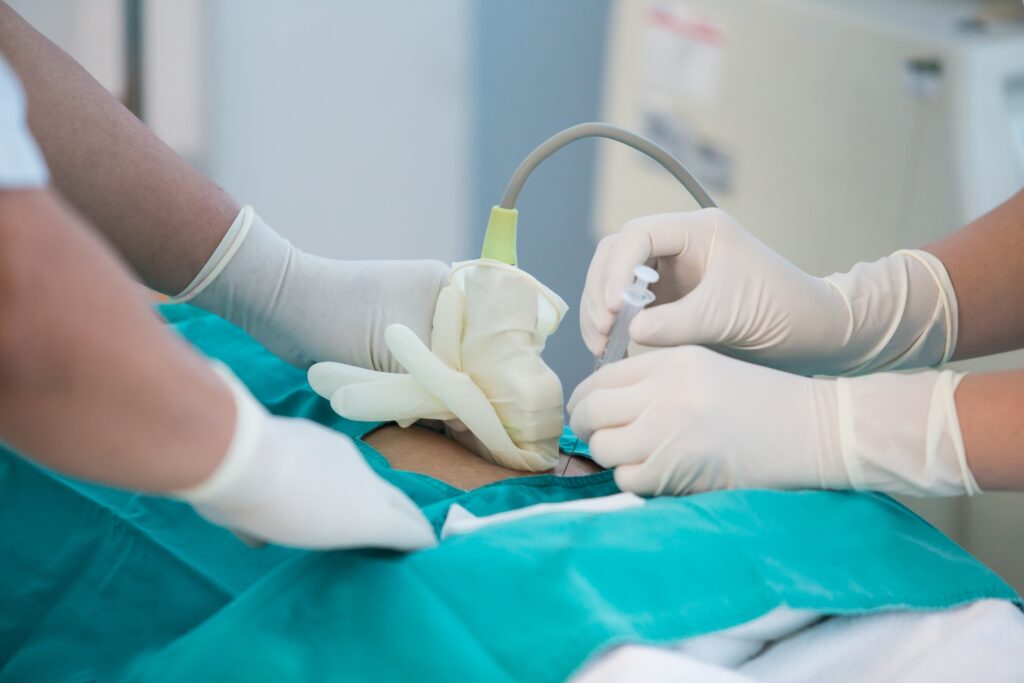
These procedures are offered when there is an increased risk based on screening results, ultrasound findings, family history, or other medical factors. All procedures are performed in our office by board-certified Maternal-Fetal Medicine specialists.
Amniocentesis
Amniocentesis is typically performed between 15 and 22 weeks of pregnancy. Using continuous ultrasound guidance, a thin needle is safely inserted through the abdomen to remove a small amount of amniotic fluid. This fluid contains fetal cells that can be analyzed for genetic and chromosomal conditions.
What Amniocentesis Can Detect
- Chromosomal conditions (e.g., Down syndrome, trisomy 18)
- Certain genetic disorders
- Neural tube defects (with AFP analysis when indicated)
- Fetal infections (in select cases)
During the Procedure
- Performed in a comfortable outpatient setting
- Procedure typically takes only a few minutes
- Ultrasound is used throughout for guidance and safety
After the Procedure
- Avoid strenuous activity, heavy lifting, and sexual intercourse for 24–48 hours
- Mild cramping may occur
- Preliminary results may return within a few business days
- Final results may take up to two weeks
Chorionic Villus Sampling (CVS)
CVS is performed between 10 and 13 6/7 weeks of pregnancy and allows earlier diagnosis than amniocentesis. The test involves collecting a small sample of placental tissue (chorionic villi), which shares the same genetic material as the baby.
Key Features of CVS
- Allows early diagnosis of chromosomal and genetic conditions
- Performed transabdominally at our practice (not transcervically)
- Guided entirely by ultrasound
- Typically recommended when screening or history suggests increased risk
During the Procedure
- Outpatient setting
- Quick procedure
- Mild cramping is common
After the Procedure
- Avoid strenuous activity and sexual intercourse for 24–48 hours
- Preliminary results often available within a few business days
- Complete results typically return within two weeks